
The Our Lady of the Rocks story begins with an icon found on a small reef near Perast.
According to local legend, the people of Perast decided to build a church on the same spot. But there was no island, so local sailors started creating one with stones and old ships.
Today, Our Lady of the Rocks, known locally as Gospa od Škrpjela, is one of the most famous places in Boka Bay.
Table of Contents
Quick answer: What is the Our Lady of the Rocks story?
According to local tradition, fishermen found an icon of the Virgin Mary and Child on a reef near Perast on July 22, 1452.
The people of Perast believed the icon should remain there. They began adding stones around the reef and later built a church on the new island. This tradition continues every year during Fašinada.
How the Our Lady of the Rocks story began
The legend says that fishermen from Perast noticed an icon resting on a rock in the sea. Some versions of the story say that one of the men was ill and recovered after praying before the icon.
The fishermen took the icon ashore. It is said that the icon later disappeared and returned to the same rock. The people of Perast saw this as a sign that a church should be built there.
Different versions of the legend include different details, but they all connect the icon, the reef and the sailors of Perast.
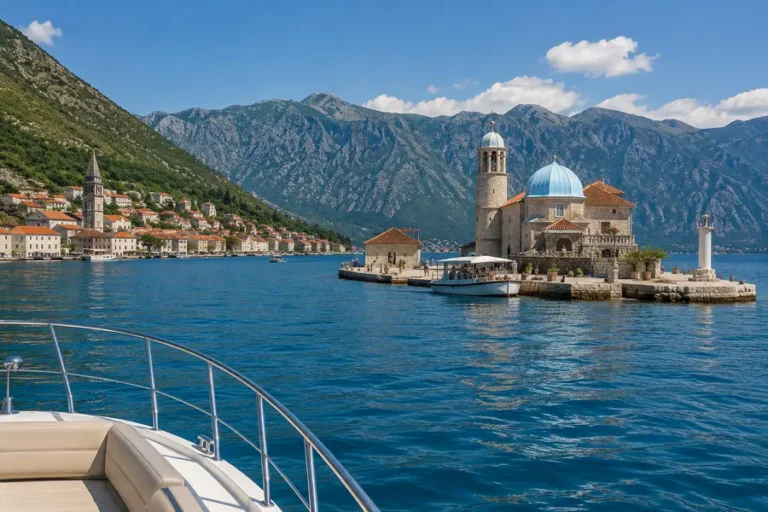
How was Our Lady of the Rocks built?
Our Lady of the Rocks is a man-made island.
Sailors and residents dropped stones around the original reef. Old ships filled with rocks were also sunk nearby to help create a solid foundation.
The work continued for generations. For local sailors, adding a stone was also a way to give thanks after returning safely from the sea.
Over time, the reef grew large enough to accommodate a church and other buildings.
The island is closely connected to the maritime history of Perast, Montenegro, where many families depended on sailing, trade, and fishing.
Fašinada: a tradition that continues today
Every July 22, boats leave Perast carrying stones for the island. The stones are dropped into the sea around Our Lady of the Rocks. This event is called Fašinada.
It remembers the day the icon was found and helps keep the island strong. Fašinada is not only a historical event. Local people still take part in it today.
It is one of the best examples of how the community of Perast keeps an old tradition alive.
.
What can you see in the church and museum?
The church looks small from the water, but there is a lot to see inside. Visitors can see religious art, silver plaques, maritime objects, and a famous handmade tapestry.
The icon of Our Lady of the Rocks
The icon connected to the legend is displayed at the altar. For local sailors and their families, it became a symbol of protection at sea and a safe return home. The church was built around the belief that the icon belonged on this spot.
Paintings by Tripo Kokolja
The church contains Baroque paintings by Tripo Kokolja, an artist from Perast. His works cover the walls and ceiling.
Do not look only at the altar. Some of the most detailed paintings are above the main church space.
Silver votive plaques
The church also contains many small silver plaques. Sailors and their families left them as signs of thanks after surviving storms, illness, or difficult voyages. Many plaques show ships, people, or religious symbols. Each one is linked to a personal story.
Jacinta Kunić-Mijović’s tapestry
One of the best-known objects in the museum is a tapestry made by Jacinta Kunić-Mijović from Perast. According to local tradition, she worked on it for around 25 years while waiting for a sailor to return.
She used gold and silver thread, as well as strands of her own hair. The hair changes from dark to grey, making the passing of time visible in the work.
.
Book your Boat Tour to see Our Lady of the Rock

from
€
€
per person
Free cancelation
For a full refund - cancellation at least 24 hours in advance, delay or rerouting of the cruiser
Non-refundable for - cancellation less of 24 hours prior to the tour
Bad weather conditions - full refund or book a new tour

from
€
€
per person
Free cancelation
For a full refund - cancellation at least 24 hours in advance, delay or rerouting of the cruiser
Non-refundable for - cancellation less of 24 hours prior to the tour
Bad weather conditions - full refund or book a new tour

from
€
€
per person
Free cancelation
For a full refund - cancellation at least 24 hours in advance, delay or rerouting of the cruiser
Non-refundable for - cancellation less of 24 hours prior to the tour
Bad weather conditions - full refund or book a new tour
Our Lady of the Rocks and Perast
Our Lady of the Rocks and Perast are closely connected.
Perast was once an important maritime town.
Its sailors, captains and families helped shape the history of the island.
From the Perast waterfront, you can see two islands.
Our Lady of the Rocks is a man-made island open to visitors.
St. George Island is a natural island with a monastery and cemetery. It is usually viewed from the boat or shore.
Visiting both Perast and Our Lady of the Rocks helps you understand the story better. On the island, you see the church and objects connected to local sailors. In Perast, you see the town where the tradition began.
How to visit Our Lady of the Rocks
Our Lady of the Rocks can only be reached by boat.
The easiest option from Kotor is the Our Lady of the Rocks and Perast boat tour from Kotor. It is a short group tour that includes both the island and Perast, so it works well for solo travelers, couples, and cruise passengers.
For families or small groups, the private Perast and Our Lady of the Rocks tour is a better fit. The boat is reserved only for your group, and the route stays inside the calmer part of Boka Bay.
Our Lady of the Rocks is also included in the 3-hour Blue Cave boat tour. This tour continues after the island toward the submarine tunnels, Mamula Island and Blue Cave, Montenegro.
.
If your main interest is Our Lady of the Rocks and Perast, the shorter speedboat tour is usually enough. Choose the Blue Cave tour when you want to see more of Boka Bay and spend more time on the water.
Before you step onto the island
Our Lady of the Rocks is an active religious site.
Wear suitable clothing when entering the church. Shoulders should be covered, swimwear should not be visible, and hats should be removed.
Allow enough time for both the church and the museum. Do not leave immediately after seeing the interior. Walk around the edge of the island and look toward Perast, St. George Island and the surrounding mountains.
The island can be busy during summer, especially when cruise ships are in Kotor, Morning visits are often calmer.
Opening hours, entrance fees and boat access may change with the season and weather, so check current information before your visit.
Why the Our Lady of the Rocks story is special
Our Lady of the Rocks is not a natural island. It was created slowly by the people of Perast. The story connects the island with local sailors, their families, and life at sea.
The church, the silver plaques, and Fašinada all show how important safe voyages were to the people who lived here. That is why Our Lady of the Rocks is more than a photo stop.
It is one of the best places to learn about the maritime history of Perast and Boka Bay.
FAQ's
What is the story of Our Lady of the Rocks?
According to local legend, fishermen found an icon of the Virgin Mary on a reef near Perast in 1452. Local people later built an artificial island around the spot.
Is Our Lady of the Rocks a natural island?
No. It is a man-made island created around a natural reef.
Why is it called Our Lady of the Rocks?
The name refers to the icon of the Virgin Mary found on a rock and to the stones used to build the island.
When was the icon found?
According to local tradition, the icon was found on July 22, 1452.
What is Fašinada?
Fašinada is an annual event held on July 22. Local people carry stones by boat and drop them into the sea around the island.
Can you visit Our Lady of the Rocks?
Yes. The island can be reached by boat from Perast or as part of a boat tour from Kotor.